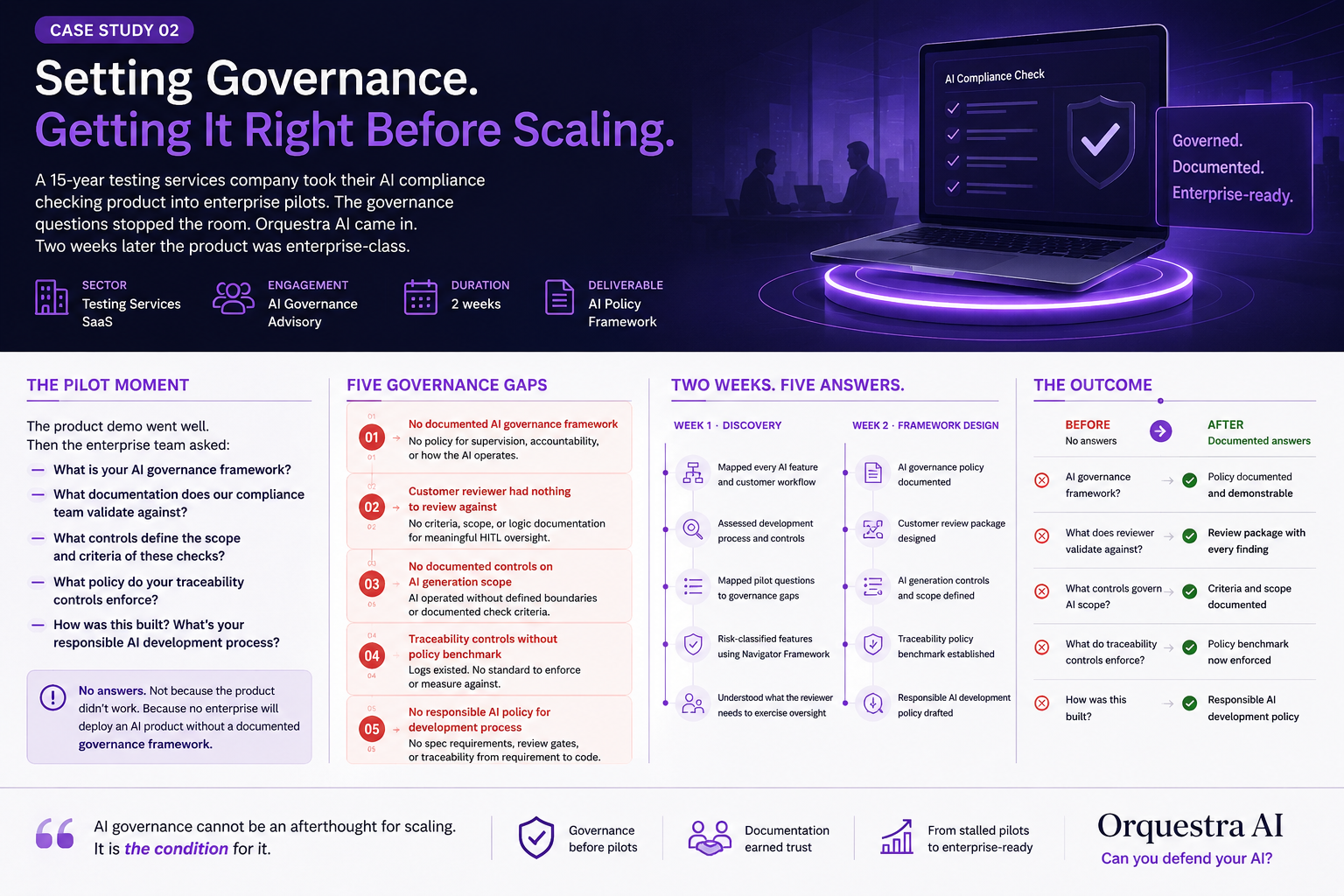
A 15-year testing services company took their AI compliance product into enterprise pilots. The governance questions stopped the room. Orquestra AI was called in. Two weeks later the product was enterprise-class.
The company had earned its credibility over 15 years — deep testing services delivery, a team that understood quality assurance at an engineering level, and a reputation built on rigorous work. The new product was a natural evolution: an AI-powered test automation platform with the capability to check compliance frameworks including SOX. The AI generates findings. The customer validates and acts on them.
The team built the product the way they knew how to build things — capable engineers, coding agents, fast iteration. The product worked. The compliance checks ran. The outputs looked right. They were confident going into the pilots.
The pilots delivered the shock.
The product demonstration went well. The AI ran the compliance checks cleanly. The output was clear. Then the enterprise security and risk team leaned in with their questions — and the room changed.
The pilots stalled. Not on capability — on governance. The product had been built to pass technical validation. It had not been built to pass enterprise procurement. Those are two different bars, and in 2026, every AI product faces both.
AI governance cannot be an afterthought for scaling. It is the condition for it.
The brief was specific: produce the documented AI governance framework that enterprise procurement required. Not policy for policy's sake — a framework that directly answered every question the pilots had exposed and made the product enterprise-deployable.
The instinct in most product teams is to ship first and add governance when someone asks for it. What the pilot room revealed is that enterprise clients ask for it before they deploy — not after. Governance that arrives after the failed pilot is damage control. Governance that arrives before the pilot is a commercial advantage.
Each question the pilot room asked mapped directly to a governance gap. The advisory identified all five, and the framework addressed all five — giving the team documented answers before the next enterprise conversation.
The AI operated under no documented policy. No defined rules for what it could generate, how it was supervised, or who was accountable for its outputs. This is the first question every enterprise security and risk team asks — and it had no answer. Without it, the product could not be considered for onboarding by any enterprise with its own AI risk governance requirements.
The product design put the customer in the HITL role — the human who validates AI findings before acting on them. Sound design. But the customer received findings with no documentation of the criteria, scope, or logic that produced them. Human oversight without documented criteria is not oversight — it is a signature on something the reviewer cannot evaluate. The responsibility transfers. The tools to exercise it do not.
No specification defined what the AI checks, how it checks, or what constitutes a finding. The AI operated as a capable but undocumented agentic engine. Enterprise clients deploying an AI product inside their compliance environment need to know exactly what that AI does and within what boundaries. Without documented controls, the product created ungoverned AI exposure in the client environment.
The product had traceability controls. They were not effective because there was no documented policy to trace against. The controls recorded what happened. There was no defined standard for what should happen. A trail without a policy benchmark is a log, not governance evidence. Enterprise procurement specifically asked what policy the controls enforced. The answer did not exist yet.
The product was built using coding agents without a spec-driven development process — no documented requirements before the agent started, no defined acceptance criteria, no formal review gates. Enterprise due diligence now covers not just how a product operates but how it was built. The "how was this built?" question in the pilot room had no structured answer.
"The product passed every technical test. It failed the governance questions. In enterprise AI procurement, those are the questions that matter."
Each component of the framework was designed to answer a specific question enterprise procurement had asked. Not generic governance documentation — direct, demonstrable answers that the team could walk into the next pilot conversation with.
Documents how AI operates in the product: what it generates, how it is supervised, who is accountable for its outputs, and how the policy is maintained. Answers “What is your AI governance framework?” directly. The foundation enterprise procurement needs before any AI product enters their environment.
Accompanies every AI finding to the customer reviewer — criteria applied, scope of the check, basis of the finding, and what the reviewer needs to assess. Transforms customer HITL from a liability transfer into a meaningful governance layer. The reviewer now has what they need to validate, not just approve.
Documented criteria for every compliance check — what it checks, how, on what basis, within what defined scope. Establishes the boundaries of autonomous AI generation. Enterprise clients can see exactly what AI does in their compliance environment, and what it cannot do without human specification.
The documented policy that the existing traceability controls now enforce. Transforms a process log into governance evidence. The controls now measure compliance against a defined standard — and the answer to “what do your traceability controls enforce?” is documented and demonstrable.
Defines how AI is used in the development process going forward — what requires human specification before coding agents begin, what requires review before shipping, what traceability is required from requirement to code. Answers the “how was this built?” question for the current product and covers all future AI-built features.
Two weeks after the engagement, every question the first pilot room had asked had a documented, demonstrable answer. The product had not changed. The governance framework around it had — and that was exactly what had been missing.
This is the commercial reality of AI products in enterprise markets. Governance is a procurement gate, not a regulatory nicety. Enterprise customers with their own AI risk obligations cannot deploy a product that cannot demonstrate how its AI is governed. The pilot that fails on governance does not get a second chance through better demos. It gets a second chance through better documentation.
The broader principle runs deeper than one company's experience. Every AI product team building toward enterprise scale faces the same threshold. The question is not whether governance will be required — it will be. The question is whether it is in place before the pilot room, or being assembled in response to it.
Both documents below are free to download and share — no email gate.
The narrative case study — the pilot shock, the five gaps, the two-week advisory, and the outcome. For sharing with leadership, prospects, and board.
The full advisory report — five findings with evidence and impact, five recommendations with actions, deliverables, and implementation roadmap. What the client received.
A Navigator Governance Advisory produces the documented AI framework, controls, and policy that enterprise procurement requires — in two weeks. Before the pilot room asks questions you cannot answer.