When your AI reviews its own code, it is not performing a review. It is performing a confirmation. The difference matters more than most engineering teams have yet noticed, and multi-agent pipelines have made it significantly harder to see.
The move to agentic AI in software development has produced a genuine productivity gain. Tasks that previously required multiple developers over several days can now be completed by agent pipelines in hours. Developer Agent writes the code. Reviewer Agent reviews it. QA Agent writes and runs the tests. The pipeline looks like a mature software development process, multiple roles, sequential stages, outputs reviewed before shipping.
The problem is not the pipeline architecture. The problem is what happens when the Developer Agent, the Reviewer Agent, and the QA Agent all run on the same underlying model. In that case, the three-stage pipeline is not three independent checks. It is one model, with the same training data, the same biases, and the same blind spots, performing all three roles in sequence. The structure creates the appearance of review. The independence required to make review meaningful is absent.
This is not a theoretical risk for edge cases. It is the default configuration for most engineering teams adopting agentic AI in 2026. The pipeline is real. The independence is an illusion.
Stated more bluntly: one model wearing three hats is one agent driving without a human navigator, the agent and its reflection, talking to each other. The agent drives. The human navigates. A pipeline of agents wearing different hats does not change which side of that line the work is on.
Why independence matters, and where the concept comes from.
The requirement for independent review is not new. Financial audit has required independence for over a century: the person who prepares the accounts cannot audit them. The auditor who reviews a company's financial statements must be independent of the management that produced them, not because management is assumed to be dishonest, but because a reviewer who shares the interests, assumptions, and blind spots of the reviewed party cannot provide the assurance that independent review is meant to produce.
The same principle applies to AI output review, with a specific additional dimension that human review does not face. When a human engineer reviews another human engineer's code, the reviewers are different people with potentially different assumptions, different approaches, and different failure modes. When the same AI model reviews code it generated, it does not just share interests and incentives. It shares the specific pattern of errors and blind spots that produced the original output.
A model that has made a systematic error, in its understanding of a requirement, in its approach to a security concern, in its handling of an edge case, will make the same systematic error when reviewing the code that contains it. The review will look thorough. The output will look consistent. Consistency, in this context, is the problem, not the evidence of quality.
"Consistency is not correctness. A model that has made a systematic error is systematic about defending it."
The agentic pipeline, how it amplifies the problem.
Single-model self-review was already a governance concern before agentic AI. An engineer using an AI assistant to review the code they had just generated with the same assistant was already creating a self-confirmation loop. But the scale of that loop was limited, one review step, typically with a human also in the chain.
Agentic pipelines change the structure of the problem in two ways that make it more significant and less visible.
First: the loop runs multiple times before a human sees the output. In a typical agentic pipeline, the same model may generate the code, generate the tests, review both, and validate the output, all before a human reviewer receives what appears to be a reviewed, tested, and validated artefact. Each stage ratifies the prior stage. By the time a human sees the output, it has already received multiple rounds of self-confirmation. The human reviewer is reviewing an output that looks like it has been through a rigorous process, not a self-confirmation loop.
Second: the multi-agent structure makes the self-confirmation invisible. When the same developer asks the same AI assistant to review their code, the self-confirmation is relatively visible, one conversation, one tool, one model. When a multi-agent pipeline runs Developer Agent → Reviewer Agent → QA Agent, the structure looks like independent review. Different agent names. Different system prompts. Different roles in the pipeline. But if the underlying model is the same, and in most current agentic deployments, it is, the structure is theatrical independence over functional self-confirmation.
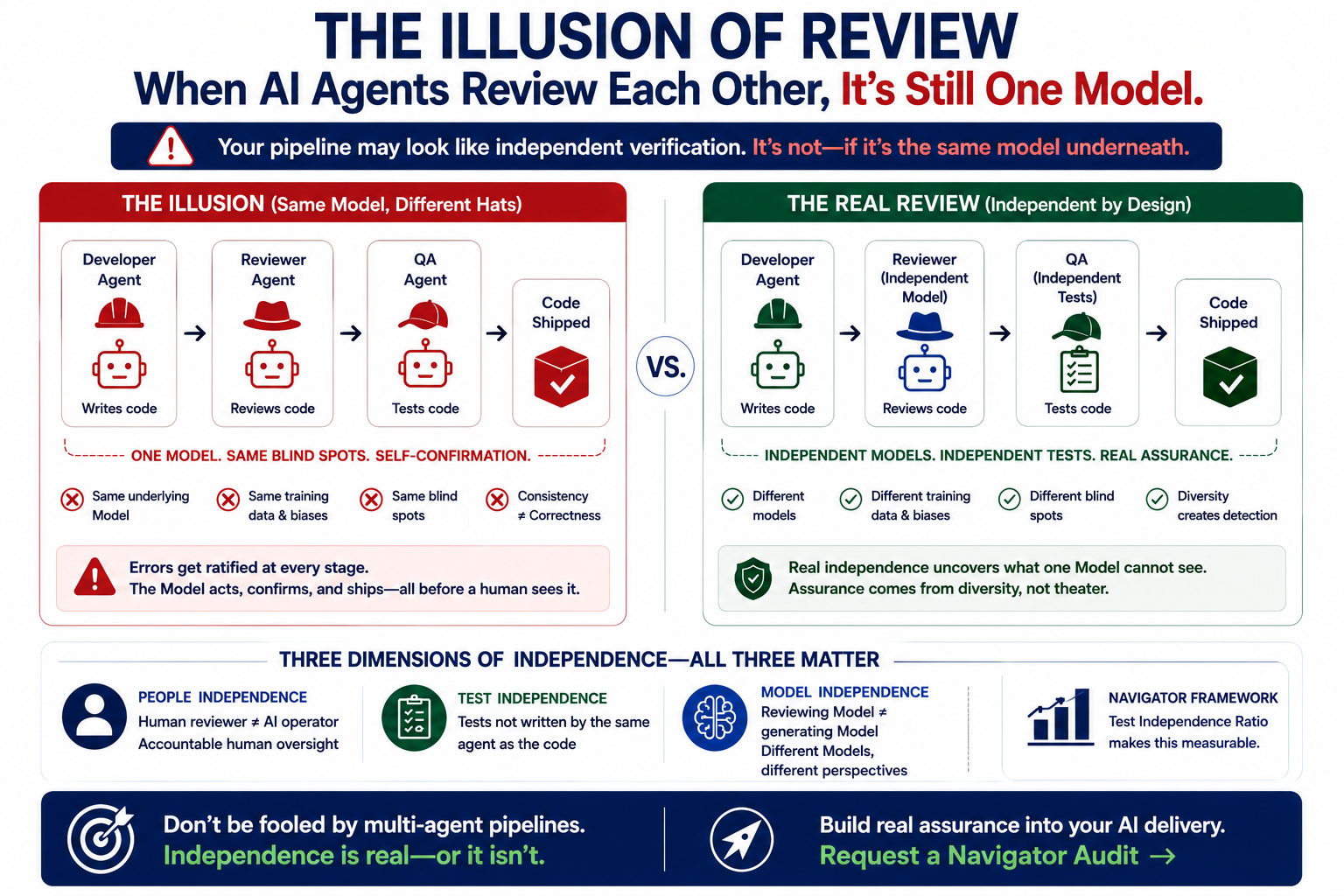
The illusion, same model, different hats. Developer Agent and Reviewer Agent share the same training data and weights. Same model shares identical blind spots, systematic errors get ratified, not caught. QA Agent writing tests on code it "reviewed" cannot test what it cannot see. Consistency across stages signals self-confirmation, not correctness. Errors ratified at every stage, model acts, confirms, and ships before a human sees the output.
Real review, independent by design. Reviewing model trained differently, different data, different architecture, different failure modes. Different blind spots mean the reviewing model can see what the generating model cannot. Tests written independently of the code, can catch what the generating model assumed was correct. Diversity across models creates detection, disagreement between models is a signal, not noise. Assurance comes from diversity, not theater, real independence produces real confidence.
The compound error problem. In a single-model self-review, an error survives one self-confirmation step. In a three-stage agentic pipeline running the same model, the same error survives three self-confirmation steps and arrives at the human reviewer looking like thoroughly reviewed, tested, and validated output. The human reviewer is the last line of defence against an error that has already been confirmed three times by the model that made it.
Three dimensions of independence, all three now matter.
Independence in AI-native development has three distinct dimensions. Most teams have some awareness of the first. Agentic AI has made the second and third critical.
-
People independenceThe human reviewer did not author the AI output under review. A developer cannot meaningfully review code they generated, with or without AI. The reviewing human must be independent of the generating process. Human reviewer is not equal to AI operator.
-
Test independenceTests were not written by the same agent that wrote the code they validate. An agent that writes code and then writes tests for that code will write tests that validate the code it wrote, not tests that challenge the assumptions it made. Test agent is not equal to code agent.
-
Model independenceThe model reviewing AI-generated output must be a different model from the one that generated it. Different training data, different architecture, different failure modes. Different blind spots are the mechanism of detection. Review model is not equal to generate model.
The most common state in engineering teams today: People Independence is understood and partially applied (teams know a human should review AI-generated code). Test Independence is rarely enforced (QA agents routinely write tests for code generated by the same underlying model). Model Independence is almost never specified (most agentic pipelines do not require different underlying models for generation and review roles).
Making independence measurable.
One of the challenges of the independence problem is that it is structural rather than detectable from the output. Code reviewed by the same model that generated it looks identical to code reviewed by an independent model. Tests written by the generating agent look identical to tests written independently. The failure is not visible in the artefact. It is visible only in the process that produced it.
This is precisely why governance controls for independence must be process controls, requirements on how the work is done, not just verification of what the work produced. The Navigator Framework addresses this through the Build gate's Test Independence Ratio.
Navigator Framework · NAV-3.10 · reviewer-quality sampling. At High risk class, sampling moves to a defined statistical confidence level, not spot checks; at Moderate, standard form. A test suite written entirely by the same agent as the code it validates cannot catch what the generating model assumed was correct — it can only confirm what the model already believed.
The TIR is a measurable, auditable number. It does not require examining the tests themselves to assess their quality. It requires knowing how they were produced, which agent, which model, and whether that agent is independent of the one that wrote the code. The process record produces the governance evidence.
What independent pipelines look like in practice.
Building genuine independence into an agentic pipeline does not require abandoning agentic AI. It requires deliberate design choices about which models perform which roles, and a process record that confirms those choices were followed.
In practice: the Developer Agent uses the team's primary model. The Reviewer Agent is configured to use a different model, one with different training characteristics and therefore different failure modes. Tests are written either by a human reviewer or by an agent running a different model from the one that generated the code. The process record captures which model performed which role for every build increment.
Disagreement between models in this configuration is not a problem to be resolved, it is the signal the independence is designed to produce. When the reviewing model identifies something the generating model did not, the independence is working. When the generating and reviewing models agree on everything, the question worth asking is whether they are actually independent, or whether the agreement is structural self-confirmation wearing a two-model costume.
The Navigator Framework principle. The same model that generated the code cannot review it. The same model that wrote the tests cannot be the sole validator of the code those tests cover. Independence is not a configuration option, it is a gate requirement. The Build gate does not close until the Test Independence Ratio meets the threshold for the project's risk class. Assurance comes from diversity. Not from theater.
Independence is real, or it isn't. Your pipeline doesn't get to be both.